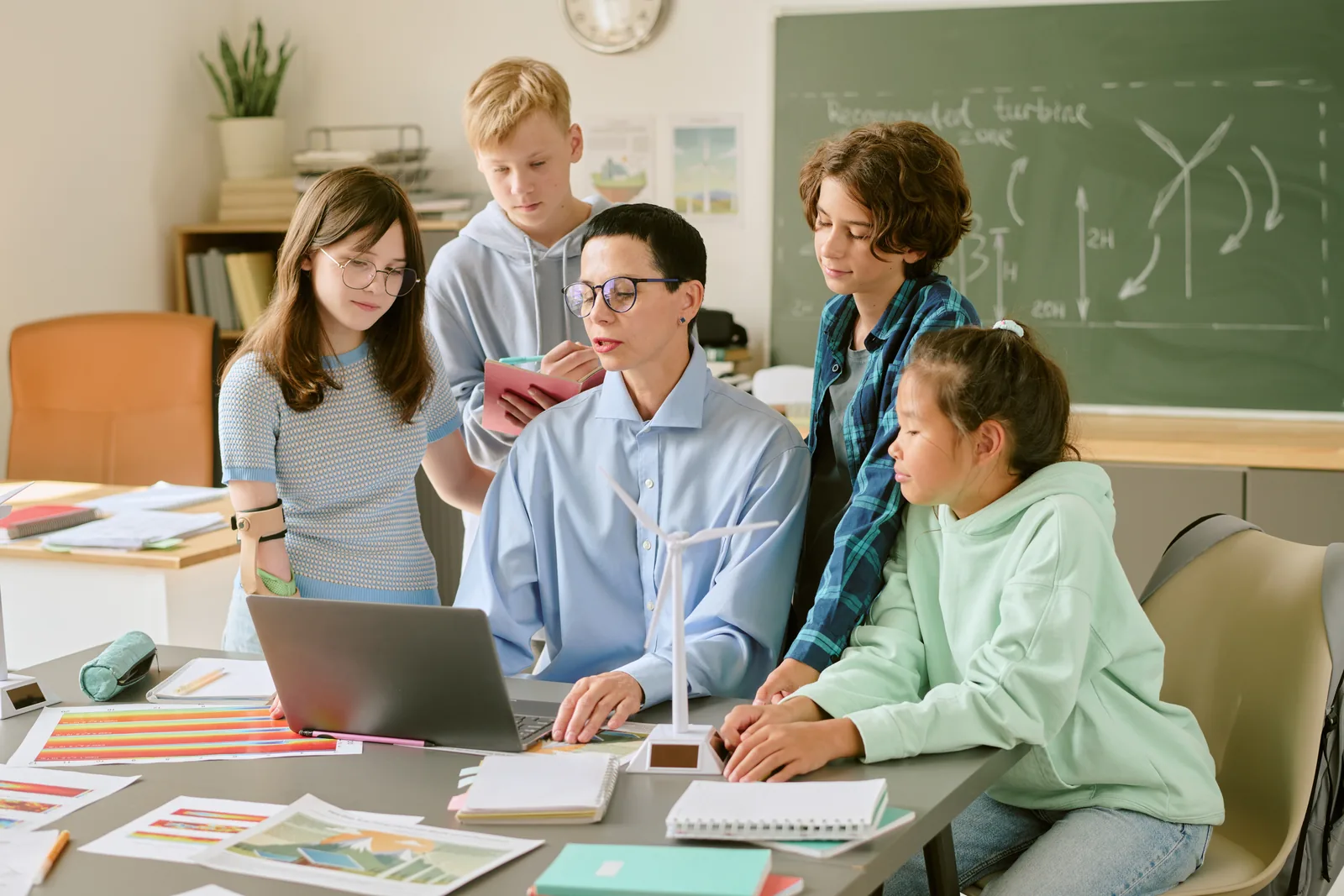
The best summer STEM project is not necessarily the most impressive object. It is the project a student can explain from the original question through the final evidence—including what failed, what changed, and what the results cannot prove.
Before buying a kit or choosing from a giant idea list, make four decisions:
- Is this a science investigation or an engineering design?
- What exactly will be measured?
- Can it be completed safely with the available time, space, materials, and supervision?
- What record will show the student's thinking?
Those decisions turn “do a STEM project” into a manageable piece of work.
First choose the right lane
Science and engineering overlap, but they do not ask the same primary question.
Science lane: investigate what happens
A science project asks a testable question about the world.
How does the thickness of one insulation material affect the rate at which warm water cools under the same conditions?
The student identifies:
- the independent variable—the one factor deliberately changed;
- the dependent variable—the outcome measured;
- controlled variables—the relevant conditions kept as consistent as possible;
- a comparison and a procedure;
- enough observations or trials to interpret the result honestly.
The Science Buddies variables guide recommends changing one factor at a time for a beginner fair test because changing several makes the cause of a difference harder to identify. More complex research can use different designs, but it also requires more expertise.
Engineering lane: design a solution
An engineering project starts with a problem, intended user, criteria, and constraints.
Design a container that keeps a fixed volume of water within a defined temperature range for 30 minutes, using no more than $10 of reusable materials.
The student identifies:
- who has the problem and what they need;
- criteria that define success;
- constraints such as cost, size, time, materials, accessibility, or waste;
- two or more possible designs;
- a fair way to compare performance;
- what to change after the first test.
NASA JPL's middle-school engineering guide emphasizes defining criteria and constraints, evaluating possible solutions systematically, testing them, and improving a design from evidence. A model that merely looks finished has not completed that cycle.
Pass the feasibility and safety gate
Complete this before the first purchase or data collection.
| Gate | Required answer |
|---|---|
| Question or problem | One sentence the student understands |
| Outcome | A quantity, observation rule, or pass/fail criterion |
| Time | Build/research time plus repeated test time fits the calendar |
| Cost | Maximum budget and already-available materials |
| Space | Safe location for setup, storage, and cleanup |
| Tools | Who may use each tool and what supervision is required |
| People/data | Permissions, privacy, and competition rules checked first |
| Stop condition | A clear reason to pause or abandon an unsafe/unworkable plan |
Do not improvise projects involving pathogens or unknown microbes, culturing body or environmental samples, dangerous chemicals, medications, ingestion, explosives, projectiles, high heat, mains electricity, unsafe batteries, pressurized containers, risky machinery, wildlife handling, or experiments intended to affect a person's health or behavior. Do not collect sensitive personal data or images without a legitimate plan and informed permission.
If a project involves people, vertebrate animals, biological materials, hazardous tools, or a competition, get the current teacher, fair, organization, and guardian rules before the work begins. School and fair review requirements vary. A viral video is not a safety protocol.
Use a one-page project canvas
For a science investigation
- Question: How does ___ affect ___ under ___ conditions?
- Reason: Why is this question worth testing?
- Background: What concepts and techniques must be understood first?
- Prediction: What result is expected, and why?
- Change: What one factor will vary?
- Measure: What will be observed, with what unit or rule?
- Controls: What relevant conditions will stay consistent?
- Procedure: Could another person repeat it from the written steps?
- Analysis: What comparison or graph will answer the question?
- Limits: What uncertainty or alternative explanation remains?
For an engineering design
- User and need: Who needs what solved?
- Criteria: What measurable performance counts as success?
- Constraints: Budget, size, time, materials, safety, accessibility, waste.
- Research: Which science and existing solutions inform the design?
- Alternatives: At least two plausible ideas before choosing.
- Prototype: The smallest model that can test the important feature.
- Test: Same conditions and measurements for each design.
- Revision: Which result will determine the next change?
- Explanation: Which criteria were met, missed, or traded off?
Background research should answer questions that help design or interpret the project—not become a general report about the entire topic. The Science Buddies research-plan guidance recommends starting from the project question, identifying relevant concepts and techniques, and discarding interesting material that does not help answer it.
Eight starter ideas that still require a real question
These are directions, not ready-made protocols. Check age, safety, materials, local weather, and fair rules.
1. Passive cooling or insulation
Science: compare one material property under controlled conditions. Engineering: design a container or shade structure to meet a temperature criterion.
2. Paper or recycled-material structures
Design a bridge, tower, shelf, or package with limits on material, span, mass, or size. Choose a safe load-testing method and define failure before testing.
3. Water use at home
Measure a non-sensitive pattern such as faucet flow or water used by a routine, then design and evaluate a change. Do not claim household data represent a community without appropriate sampling.
4. Shade and surface temperature
Compare surfaces or shade conditions at consistent times and locations with appropriate tools. Record weather and measurement limits; do not touch dangerously hot surfaces or work in unsafe heat.
5. Wind-turbine blade models
Using a safe low-voltage educational setup, test one blade feature or design criterion. An adult controls tools and electrical safety. Keep fan distance and measurement method consistent.
6. Accessibility redesign
Choose an ordinary object, instruction sheet, or digital flow and define a specific user barrier. Research established accessibility guidance, prototype an improvement, and test against criteria without pretending to speak for users the student has not consulted.
7. Public-data investigation
Use a documented government, scientific, or local open dataset to ask one narrow question. Record definitions, missing data, geography, date range, and what the dataset cannot show. Correlation alone does not establish cause.
8. Algorithm or app prototype
Define one user task, success measure, input, and output. Build the smallest testable version, include privacy and accessibility checks, and compare performance on a small set of planned cases. Do not collect real sensitive data just to make the demo look realistic.
Free starting resources are available through the National Science Foundation's K–12 engineering directory, NASA/JPL education pages, and many public libraries. A resource's presence on a reputable directory does not remove the need to read its grade, safety, material, and supervision requirements.
Keep the project log
Use a bound notebook or a dated digital document. After every work period, record:
- date and goal;
- research source or design decision;
- materials and exact setup;
- observation or raw data;
- photo or sketch, if safe and useful;
- unexpected event or failure;
- what will stay the same next time;
- what will change and why.
Never replace unexpected data with the result that “should” have happened. If a measurement was recorded incorrectly, mark it and explain the decision to exclude or repeat it. Keep raw data separate from later calculations.
The procedure should be specific enough for someone else to follow. Science Buddies' experimental-procedure guide stresses reproducible steps, measurement, consistent controlled conditions, comparisons, and repeated testing. The right number of trials depends on the project and any fair rules; “three” is a common classroom minimum, not a universal guarantee of reliable evidence.
Analyze without overselling
At the end, the student should be able to answer:
- What was the exact question or design problem?
- What was changed, compared, or built?
- What was measured, and how?
- What pattern appears in the raw data?
- Does the evidence support the prediction or meet the criteria?
- Which uncertainty, error, or tradeoff matters most?
- What would be changed in a stronger next test?
“The prototype failed” is not an empty result if the test reveals why a criterion was missed. “The experiment worked” is not a complete conclusion if the evidence is noisy or the procedure changed midway.
Finish with a small evidence package:
- project question or problem statement;
- short background and sources;
- procedure or design criteria;
- raw data and labeled graph/table;
- photos or sketches that do not expose private information;
- conclusion and limitations;
- next iteration.
Keep the adult in the right role
An adult should own safety, permissions, transportation, purchasing, and controlled access to tools. The adult can help locate an expert or ask questions such as “What evidence would change your mind?”
The student should own the project question, choices, measurements, log, analysis, and explanation. A parent-built display with student-owned data is still a parent-built display.
If the student needs a model for organizing spaced quantitative practice, use the summer math practice plan. If equipment or research access is the barrier, start with the public-library audit rather than assuming a purchase is necessary.
Check current opportunities, but do not build around a headline
NASA lists national and local student challenges, internships, hackathons, and grade-specific opportunities. Its current opportunities page also shows why details matter: some programs require a team, educator, school type, age or grade, application, deadline, travel, or months of work.
Verify the official 2026 page before promising participation. If no program fits, the project can still be complete. The core result is a question the student tested honestly and can explain—not a logo on the certificate.
Sources
- U.S. National Science Foundation — Engineering Educational Resources (2026-07-23)
- NASA JPL Education — NGSS Engineering: Middle School (2026-07-23)
- Science Buddies — What Are Variables? (2026-07-23)
- Science Buddies — Preparing Experimental Procedures (2026-07-23)
- NASA — STEM Opportunities and Activities for Students (2026-07-23)
Frequently asked questions
What is a good summer STEM project for a middle-school student?
Choose a familiar problem that can be tested safely with ordinary materials, such as comparing insulation designs, measuring shade and surface temperature, testing a paper structure, or analyzing a public dataset. The student still needs to define the actual question, measure, and constraints.
Does a STEM project need to be entered in a science fair?
No. A project can end with a tested prototype, data display, short report, or presentation to one trusted reader. If it will enter a fair or competition, obtain the current rules before collecting data or building.
How much should a parent help with a STEM project?
Adults should control safety, permissions, purchasing, and any hazardous tools; ask questions; and help locate reliable instructions. The student should own the question, choices, measurements, project log, interpretation, and explanation of limitations.
Keep reading

My Child Failed a Class: What Should We Do Next?
Protect deadlines, get the official school answer, understand why the course was failed, and build a recovery plan that addresses both credit and learning.
Read article →
What Is Credit Recovery and How Should Parents Evaluate It?
Verify who authorizes the credit, inspect the real program, track completion and learning separately, and protect the prerequisites your teen will need next.
Read article →
Does My Child Need Summer Tutoring?
Turn a low grade or summer worry into a specific decision: verify school requirements, identify the real need, compare alternatives, and test tutoring with a review point.
Read article →