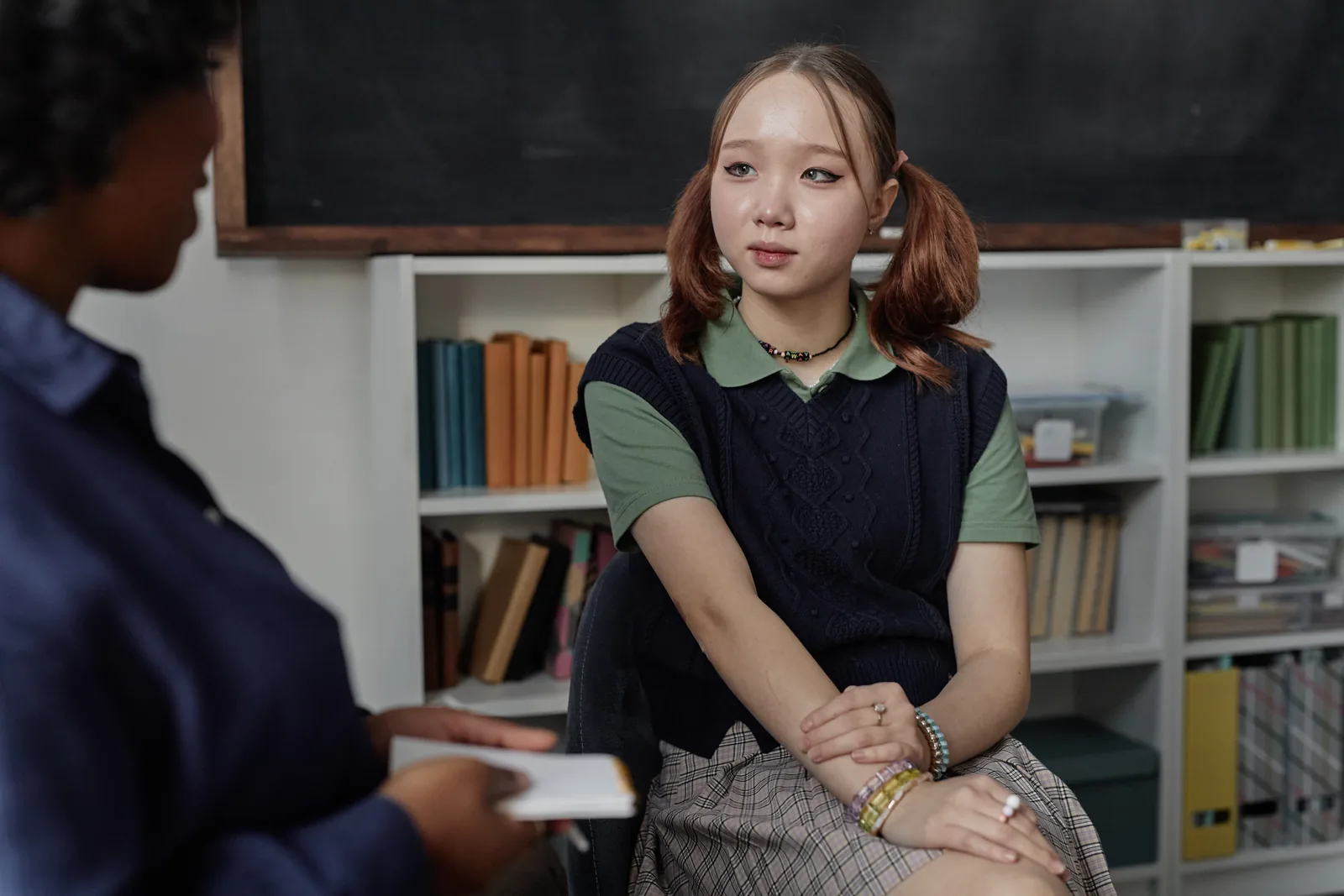
To talk about school without creating an interrogation, choose a calmer moment, share one specific observation, ask an open question, listen before advising and agree what kind of help—if any—is wanted next.
Use notice–ask–listen–agree
Notice
State what you have actually observed:
“I noticed homework has run past the planned stop three evenings this week.”
Avoid a motive or character judgement such as “You don't care” or “You're hiding something”.
Ask
Use one open question:
- “What is making those tasks take longer?”
- “Which part of the day is most difficult?”
- “What have you already tried?”
- “What do you wish the adults understood?”
The NHS recommends open questions and helping a teenager feel safe to talk. A teenager may worry that disclosure will make the situation worse; explain what you can keep private and what safety concerns require adult action.
Listen
Reflect the main point before solving:
“It sounds as though the instructions arrive in different places, and you feel I am checking the result before you have found the task.”
You can disagree later. First check that you understood.
Agree
Ask:
“Would you like me to listen, help you plan, help you write a question, or contact someone with you?”
Agree one next step, who owns it and when you will check in. No action may be needed after an ordinary bad day.
Replace stacked questions
Instead of:
“How was school? What lessons? Any homework? When is the test? Why haven't you started?”
Try:
“Do you want ten quiet minutes first, or is there one thing from today you want to get out of your head?”
Make space for conversation that is not always about performance.
Prepare for a school conversation
If a pattern needs school input, gather:
- the learner's description;
- two or three concrete examples;
- what has already been tried;
- the exact question or support requested;
- the learner's preference for involvement.
Use the observe–ask–school–review guide to avoid presenting a label as a diagnosis.
Keep boundaries calm and clear
Listening does not remove boundaries around attendance, safety or household responsibilities. State the boundary and the reason, invite the teenager's view on implementation and avoid arguing every point at once. NHS advice also suggests allowing privacy and learning from safe mistakes while maintaining a calm, consistent presence.
Use the secondary-school parent guide for 1/3/6-week check-ins. If the conversation reveals a specific academic support question, the does-my-child-need-a-tutor guide starts with school and learner evidence rather than a sales decision.
Choose the purpose before starting
Ask yourself whether you need to:
- reconnect and understand;
- clarify one practical fact;
- make a joint decision;
- raise a repeated concern;
- respond to an urgent safety or wellbeing issue.
Do not combine all five into one conversation. A casual check-in becomes an interrogation when it suddenly covers marks, attendance, friends, homework and the future.
Use notice–ask–listen–agree
Notice
Describe a pattern without a diagnosis:
I noticed you have opened the homework platform several times and then closed it without starting.
Ask
What is happening at that point?
Prefer a question that can reveal instructions, workload, confidence, relationships or access.
Listen
Reflect before solving:
It sounds as though you know the topic, but you are not sure what the teacher expects in the final answer.
Agree
Would it help to write the exact question for the teacher now, or would you rather do that at school tomorrow?
State when you will check back. Do not monitor continuously.
Work through a difficult example
Parent concern: a low mock result and several late evenings.
Unhelpful opening: “Why didn't you revise? You are always on your phone.”
Evidence-led opening:
I saw the mock result and noticed work has been going late this week. I don't know whether the main issue is workload, the subject or something else. What feels hardest about it?
If the teenager says “nothing” or “I don't know”, reduce the demand:
That's okay. Would it be easier if I asked about the paper, the workload or how school has felt?
Allow the answer to be different from your first explanation.
Respond to “fine”
“Fine” can mean the timing is poor, the question is too broad, privacy is needed or the teenager does not yet have words for the experience.
Try:
- sharing the observation and leaving space;
- offering two times to talk;
- asking about one event, not “school”;
- talking while walking or doing another activity;
- stating clearly that safety concerns can always be brought to you;
- identifying another trusted adult if your child prefers.
Do not demand disclosure in exchange for dropping the subject.
Set a boundary without making it a verdict
Where an adult must act:
I hear that you do not want me to contact school. Because this involves [specific safety/attendance/serious concern], I cannot leave it there. I will tell you what I plan to share and involve you where I can.
Follow the relevant safeguarding or professional route. Do not promise secrecy you cannot safely keep.
Copyable conversation note
What I observed:
What I do not yet know:
Open question:
What my teenager said mattered:
Help wanted: listen / think together / practical action
Agreed next step and owner:
When we will revisit it:
Reason for faster adult action, if any:
Sources
- NHS — Talking to your teenager (2026-07-23)
- NHS — Coping with your teenager (2026-07-23)
Keep reading

Signs your child may be struggling at school: next steps
Use an observe, ask, school and review process when a repeated change suggests your child needs academic, practical or wider support.
Read article →
How to help with homework without doing it
Support homework setup, task clarification and help-seeking while preserving the learner's own attempt and useful feedback for school.
Read article →
Does my child need a tutor? A parent decision guide
A neutral decision tree for defining the problem, checking school and self-study support, choosing a small trial and reviewing the evidence.
Read article →